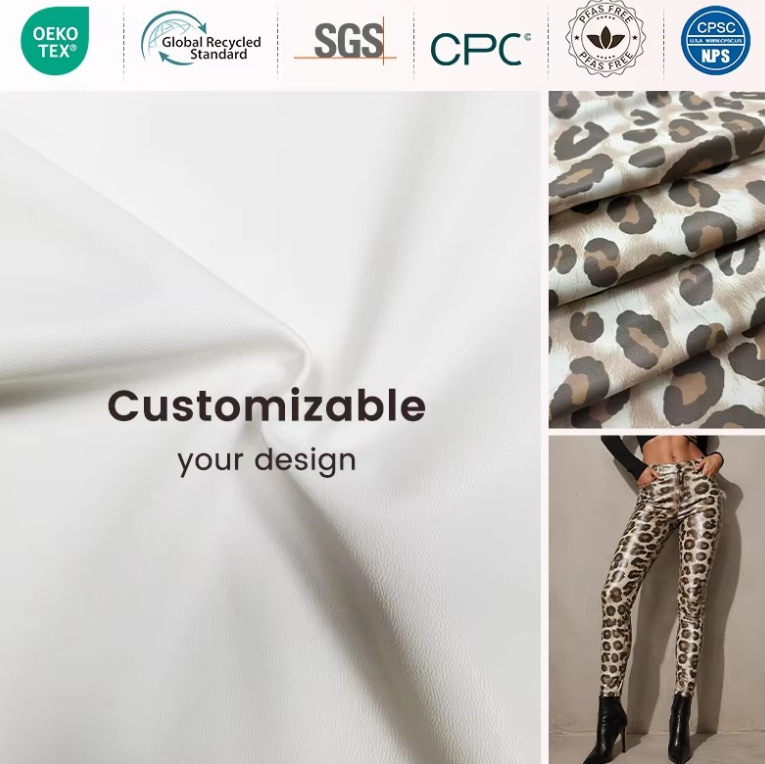
Why Printed and Textured Dress Leather Is Gaining Ground
Printed and textured finishes have moved from runway experiments into everyday dress programs. A simple slip, shift, or wrap silhouette can look flat under store lights, and surface interest solves that without adding lining weight or complicated seams. Dress leather gives designers a coated fabric that can hold a print, an emboss, or a metallic sheen while still moving with the body. The catch is that dresses are less forgiving than jackets or bags. A stiff hand shows immediately at the waist. Poor recovery leaves marks at the hips. A print that rubs off on a car seat or a lining becomes a return. That is why the latest trends are less about wild effects and more about controlled chemistry, reliable texture depth, and print systems that survive cutting, sewing, pressing, and a long day of wear.
Digital Print Rewrote the Minimum Order Rule
Digital printing changed how small labels test dress leather. Rotary and transfer methods still make sense for long runs, but digital equipment allows short runs, quick color changes, and placement prints that follow pattern pieces. A print floor with 16 machines and daily output around 10,000 to 20,000 meters can handle sample rounds and repeat orders without forcing one huge minimum. The hidden issue is ink and coating compatibility. A sharp print on paper can bleed, crack, or rub off on a coated surface. Surface energy, ink chemistry, and curing profile have to work together. Water based inks are growing for compliance and hand feel, yet they can struggle to anchor on low surface energy PVC. UV and solvent systems may hold better on certain PU faces, but they can change the final hand. For dresses, the print must also survive bias cutting, seam pressing, and friction against a lining. Flat swatch tests miss most of that.
Texture Carries Simple Silhouettes
Texture is the quieter trend, and it often outlasts a loud print. Embossed finishes can mimic reptile, pebbled grain, or fine moire without adding weight. They hide transit marks better than high gloss surfaces. On an A-line or column dress, a textured dress leather can carry the entire design. Depth control is the hard part. A shallow emboss fades after stretching or pressing. A deep emboss thins the coating, reduces flex life, and creates weak points at seams. Heat and pressure also affect the backing. Knit backing may stretch unevenly under the embossing roll. Woven backing holds registration better but can feel stiffer. Texture also changes light behavior. Matte and grained surfaces scatter light, which flatters the body and hides small defects. High gloss reflects everything, including wrinkles.
Approval Tests That Actually Predict Wear
Visual approval is only the first gate. The same print can behave differently on two coating weights, two backings, or two curing lines. Every claim should tie to a specific construction and a recognized method.
| Check | Why it matters for dresses | Common reference |
|---|---|---|
| Colorfastness to rubbing | Prints and dark shades can transfer to lining or skin | ISO 105-X12 |
| Flex fatigue | Waist, hips, and arms bend constantly | ASTM D4157 or in-house flex |
| Coating adhesion | Print or emboss can delaminate after sewing | Tape and flex test on final lot |
| Stretch and recovery | Bias cuts and fitted styles need controlled elongation | ASTM D5034 or D2594 |
| Harmful substances | Skin contact and market access | REACH Annex XVII, OEKO-TEX Standard 100 |
| Drape and hand | A stiff print can ruin a soft silhouette | Panel test plus bend length |
A sample card is not enough. Final lots should be checked after cutting and sewing, because pressing heat and needle friction change the surface. Lined dresses can abrade a print from the inside. A sewn mock up before bulk approval catches more than any flat swatch.
A Humid Print Floor Story
A print team in southern China once ran a high-gloss printed PU dress leather during the rainy season. The first rolls looked perfect. After folding and packing, some panels showed ink transfer and blocking. The print was not fully cured at the core of the roll. The surface felt dry, but residual solvent and heat were trapped as the rolls were wound tight. Humidity made it worse. The fix involved lower winding tension, an adjusted drying curve, a cooling section before rewinding, and release paper for the high-gloss lot. The next batch passed rub and blocking tests. The lesson is that a print or emboss is a process, not a surface effect. Curing, winding, and storage decide whether a beautiful dress leather becomes a return.
Match the Finish to the Dress and the Climate
Climate matters more than many buyers expect. In hot and humid regions, hydrolysis resistant PU is usually safer for long wearing dresses. In dry cold regions, PVC with the right plasticizer may resist cracking, but the hand can feel cold and stiff. For travel and packable dresses, crease recovery and weight become critical. For evening wear, drape and reflection may outrank abrasion. Printed and textured leathers are not right for every dress. A very fluid jersey like drape is hard to match with a coated fabric. A deep emboss may not suit a bias cut slip dress. High gloss print can look amazing in a lookbook and disappointing on a humid day. Honest matching beats a beautiful sample every time.
Tangshin, a synthetic PU and PVC leather maker since 2003, supports apparel and industrial programs with in-house coating, a 60,000-square-meter factory, and integrated digital print capacity. That setup helps brands keep print, texture, and base fabric under one roof, which matters when a dress program needs consistent hand feel and color across repeat orders.
