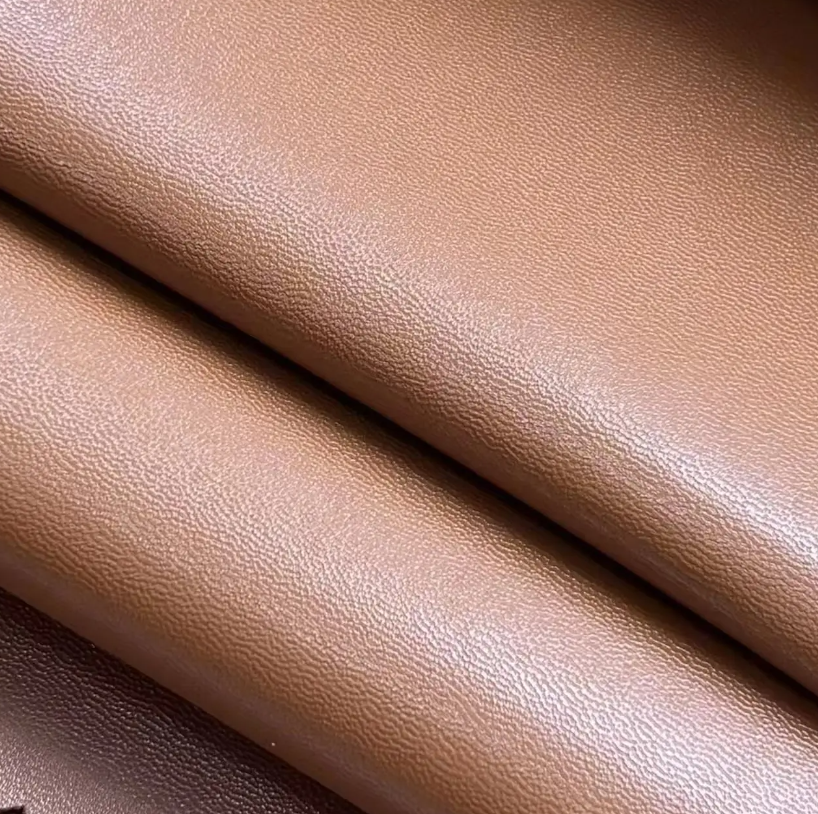
Softness That Breathes: Why Porosity Matters in Garment Leather
True softness in garment leather cannot exist without breathability. A hide that traps heat and moisture against the skin quickly becomes clammy and uncomfortable, no matter how buttery it feels on the rack. High-quality soft leathers, typically lambskin or fine sheep nappa, retain an open pore structure even after finishing. This allows air and water vapor to pass through, regulating body temperature during wear. The finest aniline and semi-aniline finishes preserve this natural porosity by using minimal surface coatings. In contrast, heavily pigmented leathers may feel smooth but often sacrifice breathability for a uniform look. When evaluating softness, press your palm against the leather for thirty seconds. If it feels cool and the leather breathes rather than becoming sticky, the hide possesses the kind of livable softness that separates a luxury garment from an uncomfortable plastic jacket.
The Chemistry of Supple: Fatliquoring and Retanning Explained
The lasting softness of a garment leather is engineered at the molecular level during wet processing. After the initial tanning, whether chrome or vegetable based, the hide undergoes retanning and fatliquoring. Fatliquors are emulsified oils that penetrate between collagen fibers, coating each bundle so they glide smoothly against one another. A well fatliquored leather bends without cracking and recovers its shape after stretching. Tannery chemists often describe this as lubricating the fiber structure from the inside out. Without sufficient and evenly distributed fatliquor, leather feels stiff and brittle, especially in cold weather. The retanning step further tunes the hand feel and fullness. Syntans and natural tannins can be combined to achieve a round, mellow touch that does not rely solely on heavy surface finishes. When these processes are precisely controlled, the resulting leather offers a depth of softness that remains stable for years, not just a few wears.
A Tactile Search: How I Picked the Right Skin for a Custom Jacket
Two years ago, I decided to commission a bespoke leather blazer. The tailor handed me three swatches of black lambskin, all labeled as garment leather. The first sample was incredibly soft to the initial pinch but left a faint oily residue on my fingers. The second felt plush but showed immediate crease marks that did not bounce back. The third had a clean, matte surface, a subtle springback when folded, and a cool, dry hand that did not change even after I rubbed it between my palms for a minute. The tailor explained that the first was overloaded with surface oils to fake softness, the second was poorly retanned and lacked fiber integrity, while the third came from a tannery that balanced fatliquor penetration with a light aniline finish. I chose the third. Wearing that blazer now, through airports and long dinners, proves that genuine softness is a structural promise, not a cosmetic trick.
Lab Tests That Speak Louder Than Sales Pitches
Marketing terms like “buttery soft” mean nothing without physical data. High-quality garment leather is validated by a set of standard tests performed by laboratories such as SGS or Intertek. Tear strength, measured in Newtons, indicates how well the leather resists ripping from a small cut. A value above 15 Newtons is generally reassuring for lightweight lambskin used in clothing. Elongation at break reveals how much the leather can stretch before tearing, which matters enormously at elbow and shoulder seams. Color fastness to rubbing, both wet and dry, ensures the leather does not stain other garments or fade onto skin. Lightfastness tests expose the leather to simulated sunlight to predict color change over a season. When a supplier provides these test reports upfront, it signals confidence in their material. This data driven approach is what separates serious leather manufacturers from commodity traders.
Cutting and Sewing: Where Soft Leather Proves Its Real Worth
A garment leather’s quality is also judged on the cutting table. Soft leathers that are overly stretchy can distort under the knife, causing mismatched panels and wavy seams. Those that are too dense may resist needle penetration, leading to skipped stitches or needle breakage. The ideal soft leather combines a uniform thickness, typically between 0.6 and 0.9 millimeters for lightweight jackets, with enough body to hold a clean edge without puckering. Factories prize leather that behaves consistently from hide to hide, because variability forces them to adjust machine tension repeatedly, which kills productivity and raises the defect rate. This is why apparel brands place immense value on leather that is not only soft to the touch but also predictable in its cutting and sewing behavior. That predictability stems from disciplined manufacturing processes upstream.
Consistency at Scale: The Manufacturing Backbone Behind Soft Leather
Delivering garment leather that checks all these boxes, batch after batch, is a manufacturing challenge that separates niche workshops from industrial partners. It requires a supply chain that can source premium raw hides with minimal defects, run precisely timed drum processes, and apply finishes with robotic uniformity. When this chain breaks down, softness becomes a lottery. Tangshine has built its reputation on mastering this consistency. By integrating hide selection, tanning, retanning, and finishing under one roof, Tangshine ensures that apparel brands receive leather with reliable softness, color uniformity, and physical performance across every shipment. For fashion labels that design collections a year in advance, this manufacturing backbone means their samples and production runs will feel identical. In a market where the touch of a garment decides a purchase decision, that reliability is a silent but powerful competitive advantage.
Table of Contents
- Softness That Breathes: Why Porosity Matters in Garment Leather
- The Chemistry of Supple: Fatliquoring and Retanning Explained
- A Tactile Search: How I Picked the Right Skin for a Custom Jacket
- Lab Tests That Speak Louder Than Sales Pitches
- Cutting and Sewing: Where Soft Leather Proves Its Real Worth
- Consistency at Scale: The Manufacturing Backbone Behind Soft Leather
