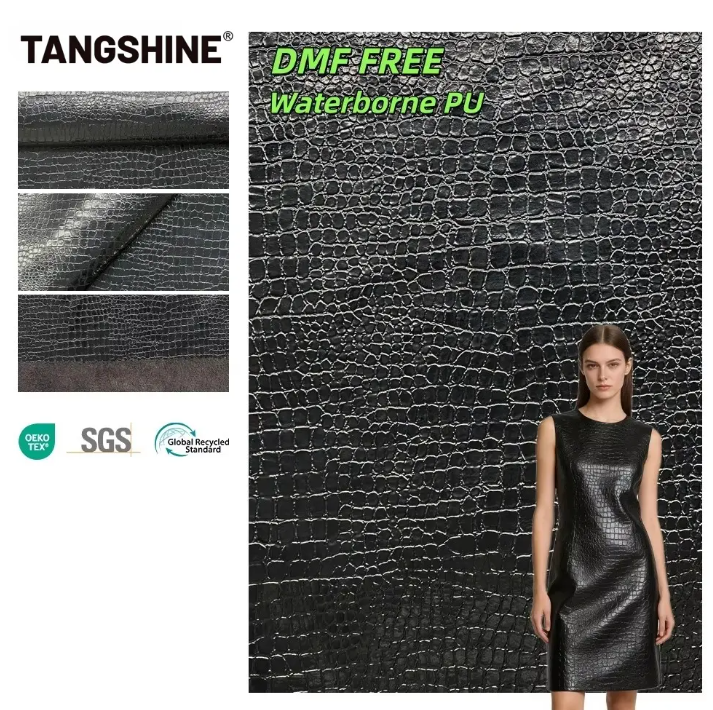
The Enduring Symbolism of Crocodile Texture
There is a reason a crocodile textured handbag stops you in your tracks when you pass a boutique window. Long before words like branding or marketing existed, certain patterns from nature had already carved deep grooves into our collective visual memory. The staggered, irregular scales of a crocodile flank are not just a surface decoration; they are a primal signal of rarity, of something ancient and untouchable. I still remember the first time I held a genuine crocodile briefcase in my hands. It was impossibly heavy, not just in physical weight but in the sheer presence it commanded. The way light caught the edge of each scale, creating a distinct, unbroken line across the bag’s body, felt less like fashion and more like armor. Faux crocodile leather takes that same psychological charge and makes it accessible. Through modern embossing technology, that exact tension between the raised, glossy scale dome and the matte, sunken groove between them is replicated with astonishing fidelity. The human eye does not analyze the material certificate first; it registers the pattern and immediately, subconsciously, assigns a value to it. This instant visual elevation is the foundation of its power.
The Precision Engineering Behind Faux Crocodile Skin
Creating a convincing faux crocodile is not a simple stamping job. It is an intense marriage of heat, pressure, chemistry, and precision tooling. A dedicated embossing roller, often laser-engraved with a pattern taken directly from a scan of a real skin, is heated to a precise temperature window. The PU or PVC coated fabric passes under this roller, and in a split second, the surface is reformed into a permanent three-dimensional landscape. I recall standing on a factory floor watching a perfectly flat, dull roll of PU leather enter the embossing station. On the other side, seconds later, emerged a material that looked damp with the luster of living scales. The engineer pointed to the micro-adjusted gap between the roller and the backing pressure drum, explaining that a variance of even a tenth of a millimeter could ruin the crispness of the scale edges or leave the groove too shallow. The quality of faux crocodile is judged by that depth, by the sharp definition of the pore, and by the subtle gloss contrast between the high points and the low points. When these details are right, even a trained hand will pause and look twice. That hesitation is the moment the material silently communicates its worth.
Why Faux Beats Genuine in Practical Luxury
The romance of genuine crocodile leather collides violently with the realities of product manufacturing. I sat with a handbag designer who had just completed her first season using real exotic skins, and she was visibly exhausted. Nearly a third of her hide investment was lost to natural scars, uneven scale distribution, and the total impossibility of matching the color and scale pattern across a production run of fifty bags. Switching to a premium faux crocodile changed her business overnight. The material arrived in consistent rolls, every meter identical to the next, allowing a near perfect cutting yield. The weight was uniform and, critically, lighter, suiting the modern demand for bags that do not feel like a burden. Color matching from one batch to the next was controlled by a spectrophotometer, not by the natural variations of animal skin. Perhaps most importantly, trading across borders became seamless. The Convention on International Trade in Endangered Species does not apply to a coated textile that merely celebrates the aesthetic of an animal without harming it. For any brand thinking globally, that compliance simplicity is a profound business advantage.
The Design Flexibility That Genuine Skin Cannot Offer
Nature imposes limits; human engineering does not. A real crocodile skin comes in a fixed size, with a fixed scale pattern determined by the species and the individual animal. Faux crocodile explodes those constraints. The scale size can be customized, making it larger and more dramatic for a statement tote, or smaller and finer for a delicate card holder. Colors can be anything from a perfectly matched brand Pantone to a pearlescent overlay that shifts with the light. I remember a startup accessories brand that launched a capsule of mini backpacks in a metallic rose-gold crocodile finish. The material had been custom run with a high-density emboss and a multi-layer coating that gave it a liquid-metal shine. That bag became their best-selling item for two years straight, copied endlessly by competitors who could source cheap approximations but never match the exact depth of that custom embossing. The genuine crocodile market could never respond to a trend like that. The lead time alone to source, treat, and match rose-gold genuine skins would have stretched beyond the season. Faux material gave a small brand the speed and audacity to lead a trend, not follow it.
The Affordable Indulgence Psychology in Consumer Markets
There is a specific, measurable consumer thrill that happens when someone picks up an accessory that feels far more expensive than its price tag. Consumer psychology research has repeatedly demonstrated that the tactile experience of a product can override visual judgment in purchase decisions. A bag with a deep, convincing crocodile emboss invites fingers to trace the scales, creating a sensory memory that associates the brand with quality and substance. This is the engine of the affordable luxury segment. A customer may not be able to articulate why a faux crocodile wallet in a deep burgundy feels special, but her hand tells her it is. That gap between the price she paid and the perceived value she experiences is where brand loyalty is forged. Smart brands leverage this relentlessly. They understand that the crocodile pattern is not just a design choice; it is a silent salesperson that whispers luxury into the customer’s ear every time she touches her bag.
Building a Brand Identity on Exotic Foundations
Watching the accessories market over the years, the brands that stand out are rarely the ones with the biggest advertising budgets. They are the ones that own a distinctive material language that customers can instantly recognize and desire. For many, that language is built on a proprietary exotic emboss. A well-chosen faux crocodile, customized to a brand’s exact specifications of scale size, gloss level, and color depth, becomes a signature as strong as any logo. This is not a commodity purchase; it is a collaborative material development project. And that kind of project demands a partner with genuine engineering depth. When a manufacturer like Tangshine, with over two decades of accumulated experience, controls the entire process from engraving the embossing rollers in house to formulating the exact coating to achieve a bespoke luster, the result is not just a roll of fabric. It is a brand asset. The vertical integration means that season after season, the color and texture stay locked in, and any ambitious new idea, from an oversized scale pattern to a glow-in-the-dark edge finish, can be prototyped rapidly and scaled confidently. That is how an accessory brand stops buying materials and starts building a legacy.
